Detailed Sunflower Embroidery Design
A Professional Embroidery Designer’s Review for Small Business Use
As an embroidery designer who’s developed hundreds of commercial designs for cafés, boutiques, florists, bakeries, and handmade brands, I approach every new machine embroidery design with two questions: “Does it translate into a strong brand asset?” and “Will it hold up across real-world applications — from staff aprons to customer tote bags?” When I first saw the Detailed Sunflower Embroidery Design, my instinct was positive — sunflowers carry warmth, authenticity, and seasonal energy. But instinct isn’t enough. So I tested it across six common small business use cases: embroidered patches, cap fronts, uniform chest logos, apron corners, tote bag accents, and product packaging tags.
First Impression: Friendly, Handmade, and Professionally Grounded
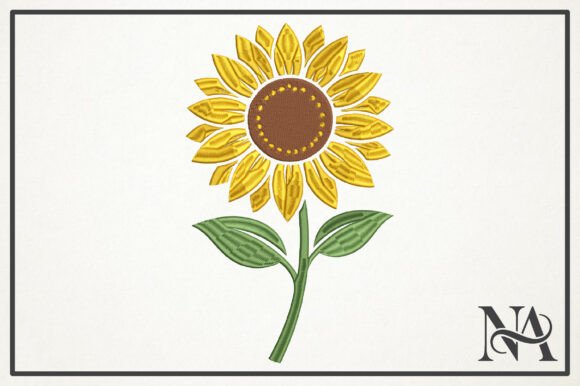
The title alone — Detailed Sunflower Embroidery Design — signals intentionality. This isn’t a generic floral clipart conversion. Paired with the description (“realistic floral art,” “golden yellow petals,” “rich brown seeded center”), it suggests thoughtful color layering and naturalistic texture — qualities that resonate deeply with audiences seeking authenticity. For a small business, that translates to trust. A bakery using this on linen aprons feels artisanal, not mass-produced. A pet brand stitching it onto organic cotton bandanas communicates care and earthiness. It leans classic with a modern hand-drawn sensibility — neither overly ornate nor minimalist. That balance makes it versatile across Single Flowers collections and broader Embroidery branding systems.
Real-World Performance Across Merchandise Types
In practice, the Detailed Sunflower Embroidery Design shines where personality meets professionalism:
- Embroidered patches: Works beautifully at 2.5”–3.5” width. The defined petal edges and textured center hold shape well when heat-sealed or sewn onto denim jackets, tote bags, or shop signage banners.
- Staff uniforms & aprons: Placed on left chests or lower right pockets, it adds visual warmth without overwhelming utility. Its moderate scale ensures legibility during service — critical for cafés or studios where customers interact closely with staff.
- Cap embroidery: Best suited for mid-crown or back-strap placement (not front panels under 2”). At 2” height, the center detail remains readable; smaller sizes risk losing the seeded texture — test before bulk production.
- Tote bag design: Scales elegantly to 4”–5” on canvas or heavy cotton. The golden-yellow-to-brown contrast pops against natural fibers, reinforcing eco-conscious or handmade positioning.
- Product packaging accents: When stitched onto kraft paper tags or fabric labels for soaps, candles, or preserves, it elevates perceived value — turning functional packaging into part of the brand story.
- Custom apparel for events & pop-ups: Looks cohesive across t-shirts, bucket hats, and drawstring bags — helping unify visual identity across temporary retail experiences.
Where to Use with Intention — Not Assumption
This design is expressive, not elemental — and that matters for execution. Avoid placing the Detailed Sunflower Embroidery Design in contexts where fine detail competes with constraints:
- On curved surfaces like baseball cap fronts under 2” — distortion risks flattening petal definition.
- At sub-1.75” sizes — the rich brown center may fill in, losing its realistic seed texture.
- On dark uniforms without verifying thread color contrast — golden yellow thread can mute on navy or charcoal unless digitized with satin-fill density adjustments.
- Over high-texture fabrics (like bouclé or heavy burlap) without upgraded stabilizer — delicate outlines may sink or pucker.
- In high-wash environments (e.g., restaurant aprons) without confirming stitch density — too many overlapping satin stitches can stiffen or crack over time.
How It Strengthens Brand Identity & Customer Connection
For small businesses, consistency isn’t about repetition — it’s about resonance. The Detailed Sunflower Embroidery Design supports that by functioning as both a standalone emblem and a flexible design asset. When used across multiple touchpoints — say, a café’s embroidered apron, reusable tote, and ceramic mug sleeve — it builds subconscious recognition. Customers begin associating that sunflower with quality, care, and local character. Unlike abstract logos, botanical motifs like this one invite emotional engagement: warmth, growth, summer, optimism. That directly supports handmade product positioning and increases perceived value — especially on Etsy or boutique shelves where shoppers choose based on feeling as much as function.
Practical Notes Every Embroidery Designer Should Apply
Before cutting thread or sending files to production, here’s what I do — and recommend you do — with the Detailed Sunflower Embroidery Design:
- Run a black-and-white test stitch-out first — reveals clarity issues invisible on screen.
- Verify how it reads at your smallest intended patch size (e.g., 1.5” wide). Does the center still read as seeded, or does it blur?
- Check thread colors against your base fabric — golden yellow behaves differently on oatmeal linen vs. black twill.
- Inspect spacing between petals and center — tight gaps may close up on low-tension machines or unstable fabrics.
- Confirm your standard hoop size accommodates the largest version you plan to use — no last-minute resizing.
- Test on your actual fabric — especially if using textured, stretchy, or recycled materials.
- Use cutaway or tear-away stabilizer appropriate for stitch density and fabric weight.
- Create a printable mockup for client approval — show it on aprons, caps, and totes side-by-side.
- Compare it beside other design assets in your brand kit — does it harmonize with fonts, icons, or secondary patterns?
- Confirm commercial licensing covers your intended use — especially for resale merchandise or white-label production.
The Detailed Sunflower Embroidery Design isn’t just another floral motif. It’s a strategic tool for small businesses building memorable, tactile brand experiences. When applied thoughtfully — with attention to scale, fabric, thread, and context — it transforms simple small business merch into meaningful connection. Whether you’re launching your first line of custom apparel or refreshing your studio’s visual language, this design earns its place as a reliable, expressive, and commercially smart digital embroidery file.