★★★★☆4.3(298 reviews)
Lace Jellyfish Embroidery
A Delicate, Dreamy Design That Demands Thoughtful Placement
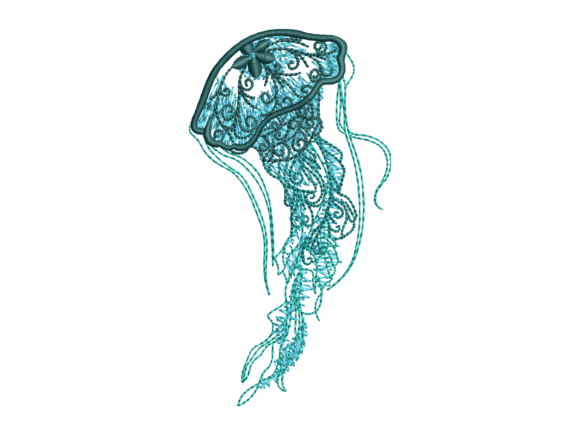
I opened Lace Jellyfish Embroidery expecting whimsy—and got it. But more importantly, I got clarity: this isn’t a bold statement piece for a baseball cap or a high-contrast tote bag logo. It’s a soft-spoken, lace-infused interpretation of marine elegance—curving tentacles, open negative space, and fine satin-stitched edges that breathe like sea foam. As a designer who’s stitched hundreds of digital embroidery files for clients (from boutique baby lines to Etsy sellers launching seasonal collections), my first instinct wasn’t “Let’s sew it right away”—it was “Where will this *live* without losing its soul?”Real Project Test: A Linen Tea Towel for a Coastal Kitchen Boutique
Last week, I prepped Lace Jellyfish Embroidery for a small-batch linen tea towel order—part of a coastal-themed kitchen line for a local shop. The fabric was medium-weight, slightly textured, and ivory—not stark white. I chose a pale silver-grey thread for the lace outlines and a barely-there blush for subtle fill accents. Why? Because Lace Jellyfish Embroidery thrives on subtlety. Its charm lies in delicacy, not dominance. On dark fabric, it risks disappearing unless you boost contrast with metallic or high-sheen thread. On thin cotton or rayon challis? The lace motifs can pull or distort without proper cutaway stabilizer underneath. I ran a test on scrap first—and noticed how the outermost tentacle tips (just three to four stitches wide) needed careful tension tuning. Not a flaw—just a cue to slow down.Where It Shines—and Where It Needs Guardrails
Lace Jellyfish Embroidery is ideal for projects where atmosphere matters more than impact:- Baby embroidery: On organic cotton onesies or muslin swaddle blankets, it reads as gentle, oceanic calm—not busy or overwhelming.
- Nursery decor: Pillow covers, framed hoop art, or linen wall hangings benefit from its airy silhouette and natural rhythm.
- Personalized gifts: Monogrammed with a single initial beside the jellyfish? Elegant. Paired with a short phrase like “Drift gently” in fine running stitch? Poetic.
- Small shop product: As a limited-run embroidered patch for a sustainable apparel brand, it adds quiet distinction—no loud branding needed.
- Stretchy fabric (like jersey or ribbed knit): The lace structure relies on stability. Without firm tear-away + cutaway combo stabilizer, those fine curves can pucker or shift.
- Caps and curved surfaces: The design’s width and fluid shape don’t wrap cleanly over crown seams. Better suited for flat panels—think back-of-cap embroidery only if the hoop size allows full clearance.
- Frequent-wash items (like kids’ towels or everyday tees): High stitch density in lace areas holds up well—but avoid dense fill stitching where it’s not needed. Check the file: does it use strategic running stitch for movement? That’s a sign of thoughtful digitizing.
- Tiny hoops (under 4”): This design needs breathing room. If your smallest hoop is 3.5”, scale down *only after testing*—and expect some loss of lace definition in the finest filaments.
What It Does for Your Brand—and What It Asks of You
When customers see Lace Jellyfish Embroidery on a finished product, they don’t just register “jellyfish.” They register *intention*. Handmade product buyers respond to craftsmanship cues—clean satin stitch transitions, balanced negative space, and confident thread color choices. That translates directly to perceived value. An Etsy seller using this on linen napkins can charge $2–$3 more per set—not because it’s complex, but because it feels considered. But here’s the trade-off: Lace Jellyfish Embroidery doesn’t shout. It won’t dominate a social media thumbnail like a bold applique design might. Its strength is in cohesion—in supporting a cohesive aesthetic across a collection (e.g., matching tea towels, aprons, and pillow covers for a seaside B&B). For commercial embroidery shops, it’s a smart add-on for clients seeking “quiet luxury,” not mass appeal.Practical Designer Notes Before You Stitch
Before committing to Lace Jellyfish Embroidery in your next project, do these five things:- Test on scrap fabric *with your exact stabilizer stack*—not just generic advice, but what you’ll actually use.
- Check thread color contrast on both light and dark backgrounds using a printable mockup. Lace loses legibility fast on low-contrast pairings.
- Review stitch density in the tentacle tips and body outline. Overly dense satin stitch in narrow areas = stiffness and breakage risk.
- Confirm hoop size compatibility. If your machine’s max is 5×7”, measure the design dimensions in your embroidery software before hooping.
- Verify licensing. Since this is a digital embroidery file delivered via ZIP or RAR, confirm whether personal use, small business resale, or digital product bundling is permitted—don’t assume.
Final Thought: It’s Not Just a Fish Design—It’s a Mood Maker
Calling Lace Jellyfish Embroidery a “fish embroidery” undersells it. Yes, it lives in the Fish category—but its real category is *atmosphere*. It’s for the maker who chooses linen over polyester, hand-stitched hems over serged edges, and quiet meaning over loud trends. Whether you’re an Etsy seller building a dreamy nursery line, a craft business owner refreshing holiday gift offerings, or a custom apparel decorator curating seasonal collections—it earns its place when used with respect for its voice. Not every design needs to command attention. Some, like this one, simply ask to be felt.
⬇️ Download Free
Free download · No sign-up required
🔗 You Might Also Like
Freebies
First Impressions: Clean, Versatile, and Quietly Confident As an embroidery desi...

Freebies
A Craft Fair Designer’s Real-World Review Before Booth Setup As an embroidery de...
Illustrations
As an embroidery designer who’s stitched over 2,000 custom orders for baby bouti...
Illustrations
As an embroidery designer who’s developed collections for boutique apparel brand...

Freebies
A Refreshing Summer Staple for Handmade Gifts As an embroidery designer who’s st...
